Executive Summary
Overall Threat Level
MODERATEConfidence Level
HIGHKey Findings
- Solar activity is low with only C-class flares observed; no Earth-directed CMEs are anticipated in the next few days.
- Geomagnetic conditions are quiet to unsettled, with Kp values reaching 3-4 but no G1 or greater storm expected through 21 June.
- RTK operations should remain feasible, but longer initialization times and 2-5 cm accuracy degradation are possible, especially for high-latitude and long-baseline surveys.
Current Space Weather Conditions
Solar Activity
LOW| Parameter | Value |
|---|---|
| Solar Flux (10.7cm) | 113 sfu (forecast for 17 Jun) |
| Active Regions | 4 numbered regions; Region 4465 is the most active, with beta-gamma magnetic complexity |
| Flare Probability | M-class: 15%, X-class: 1% |
Geomagnetic Activity
UNSETTLED| Parameter | Value |
|---|---|
| Kp Index | 3-4 (max 4.00, no G1 storm expected) |
| Planetary A Index | 10-15 (A_p forecast through 19 Jun) |
Space Weather Storms
| Storm Type | Current Status | Forecast |
|---|---|---|
| Geomagnetic Storms | No G1 or greater storms expected through 21 June; isolated active conditions possible on 19 June due to coronal hole high-speed stream effects. | - |
| Solar Radiation Storms | No S1 or greater solar radiation storms expected. | - |
| Radio Blackouts | No R1 events expected through 19 June; slight chance of R1-R2 after 20 June with the expected return of old Region 4455. | - |
Geomagnetic Activity Trends - Last 7 Days
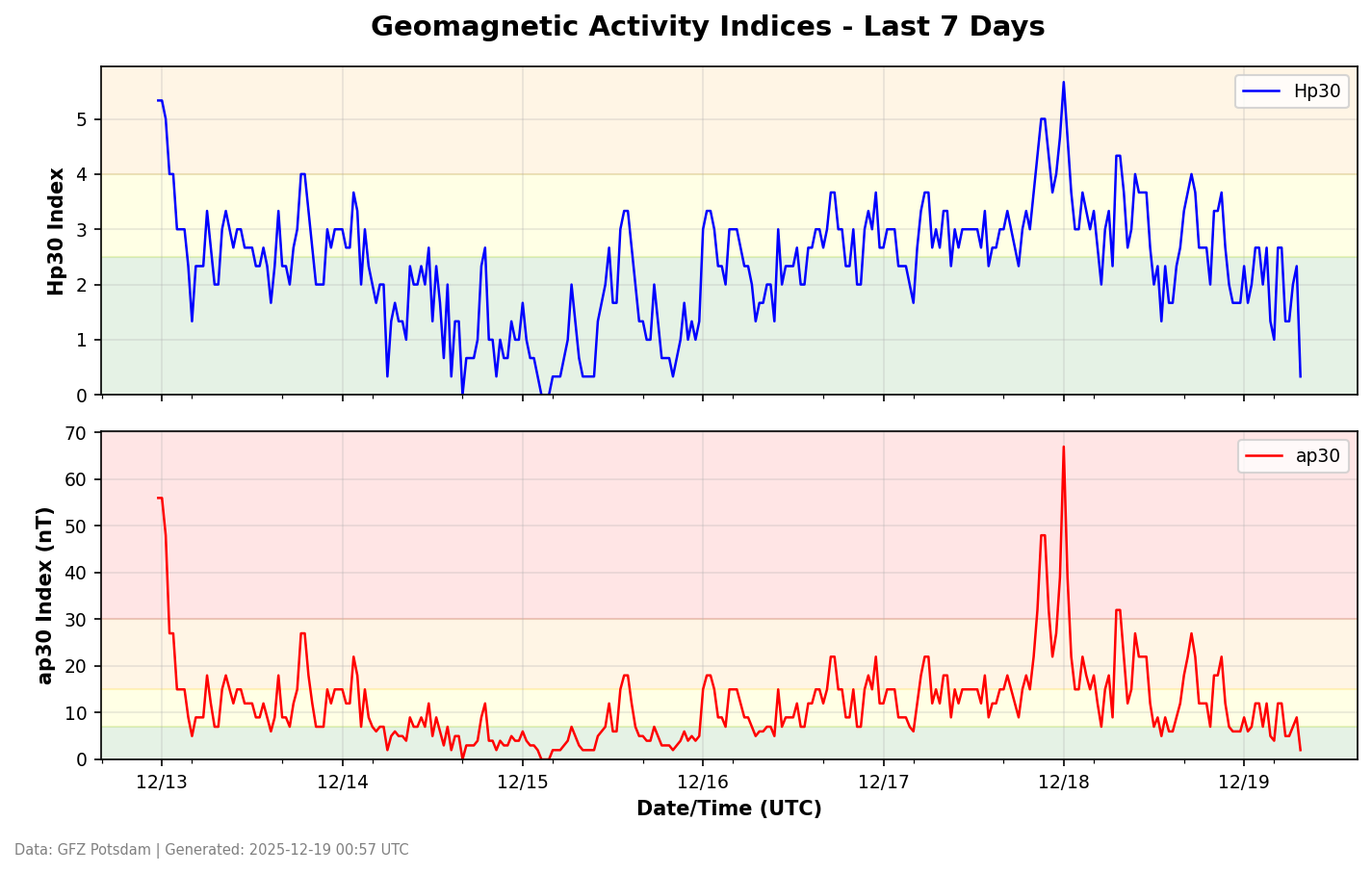
Graph Statistics
| Parameter | Value |
|---|---|
| Data Points | 337 |
| Period | 2026-07-27 23:30 UTC to 2026-08-03 23:30 UTC |
| Max Hp30 | 6.00 |
| Max ap30 | 80 nT |
Activity Levels
Data Source: GFZ Helmholtz Centre Potsdam - Geomagnetic Observatory Niemegk
Note: Hp30 and ap30 indices provide high-resolution (30-minute) measurements of geomagnetic activity.
Solar F10.7 Flux
F10.7 flux graph temporarily unavailable. Please check the data source connection.
Surveying Operations Impact Assessment
Positioning Accuracy
MODERATE RiskAffected Regions: High-latitude geomagnetic regions (>55 degrees), Long RTK baselines (>30 km)
Expected Impact: Minor ionospheric delay and scintillation, with occasional RTK ambiguity resets; fixed solutions are likely but may require more time.
Accuracy Degradation: 2-5 cm degradation in high-latitude/long-baseline operations; typically <2 cm for shorter mid-latitude baselines.
RTK GNSS Performance
MODERATE impact; baselines under 20 km remain reliable, while longer baselines may experience more intermittent fixed solutions.Initialization Time: RTK initialization likely 1-3 minutes; occasional >3 minute delays in active ionospheric conditions.
Network RTK Stability: Network RTK remains generally stable, though correction age may increase during local disturbances; use dual-frequency/multi-constellation receivers.
Survey Operations
Recommended Methods:
- RTK with baseline lengths limited to 15-20 km
- Network RTK using atmospheric corrections
- Static or PPK for high-precision control points
Session Duration: Increase static occupation times by 50% if Kp reaches 4; plan for 15-30 extra minutes per RTK session to account for re-initialization.
Quality Control:
- Use dual-frequency/multi-constellation receivers with ionospheric correction enabled
- Monitor baseline residuals and RTK fixed status
- Re-observe critical points when conditions change
- Record PDOP and satellite geometry during each session
Surveying Operations Recommendations
Immediate Actions
- Check current Kp forecast before field mobilization
- Keep RTK baselines under 20 km where possible
- Use network RTK or PPP-RTK services to mitigate ionospheric errors
Survey Planning
- Schedule high-accuracy stakeout for periods with Kp below 4
- Allow extra time for RTK initialization and potential restarts
- Use static or PPK methods for control networks if Kp remains elevated
Equipment Considerations
- Enable multi-constellation and ionospheric correction features
- Use ground-plane or choke-ring antennas for better multipath rejection
- Verify correction link stability and data quality before starting
Field Crew Guidance
- If fixed solution is not achieved within 3 minutes, re-initialize at a new location
- Document any dropped fixes and re-observe affected points
- Avoid critical observations during local afternoon ionospheric peak, if possible
Risk Timeline
Next 24 Hours
- Kp index up to 4 expected
- No G1 geomagnetic storms expected
- Quiet-to-unsettled geomagnetic conditions with low solar flare activity
Next 3 Days
- A_p index 10-15 with no G1 storms through 19 June
- Possible active high-latitude periods on 19 June due to coronal hole high-speed stream
- Increasing chance of R1-R2 radio blackouts after 20 June with return of Region 4455
Extended Outlook
- No items specified